





When Washington calls something “historic,” you expect the fine print to stay steady. But in the case of the newly announced US India Trade Deal interim trade agreement, the fine print has already shifted. Quietly. Subtly. Strategically.
Within days of unveiling what it described as a “path forward” in bilateral trade ties, the White House revised its official factsheet. References vanished. Words changed. Commitments softened. And observers on both sides of the Pacific started asking the obvious question: what exactly changed—and why?
Let’s unpack this step by step. Because in trade diplomacy, one word can be the difference between a handshake and a loophole.
A “Historic” US-India Trade Deal — But History Gets Edited
Last week, after nearly a year of negotiations that began in February 2025, India and the United States announced an interim trade agreement. The framework followed a direct phone conversation between Prime Minister Narendra Modi and US President Donald Trump, signaling high-level political backing.
The White House released a detailed factsheet describing what it called the “path forward.” It painted a picture of expanding trade flows, reduced tariffs, and strengthened digital cooperation.
But then something interesting happened.
The document was revised. US India Trade Deal
And the revisions weren’t minor formatting tweaks. They altered tone, scope, and in some areas, substance.
In diplomacy, words aren’t decoration. They are commitments. So when wording shifts from “committed” to “intends,” markets notice. Governments notice. And so should you.
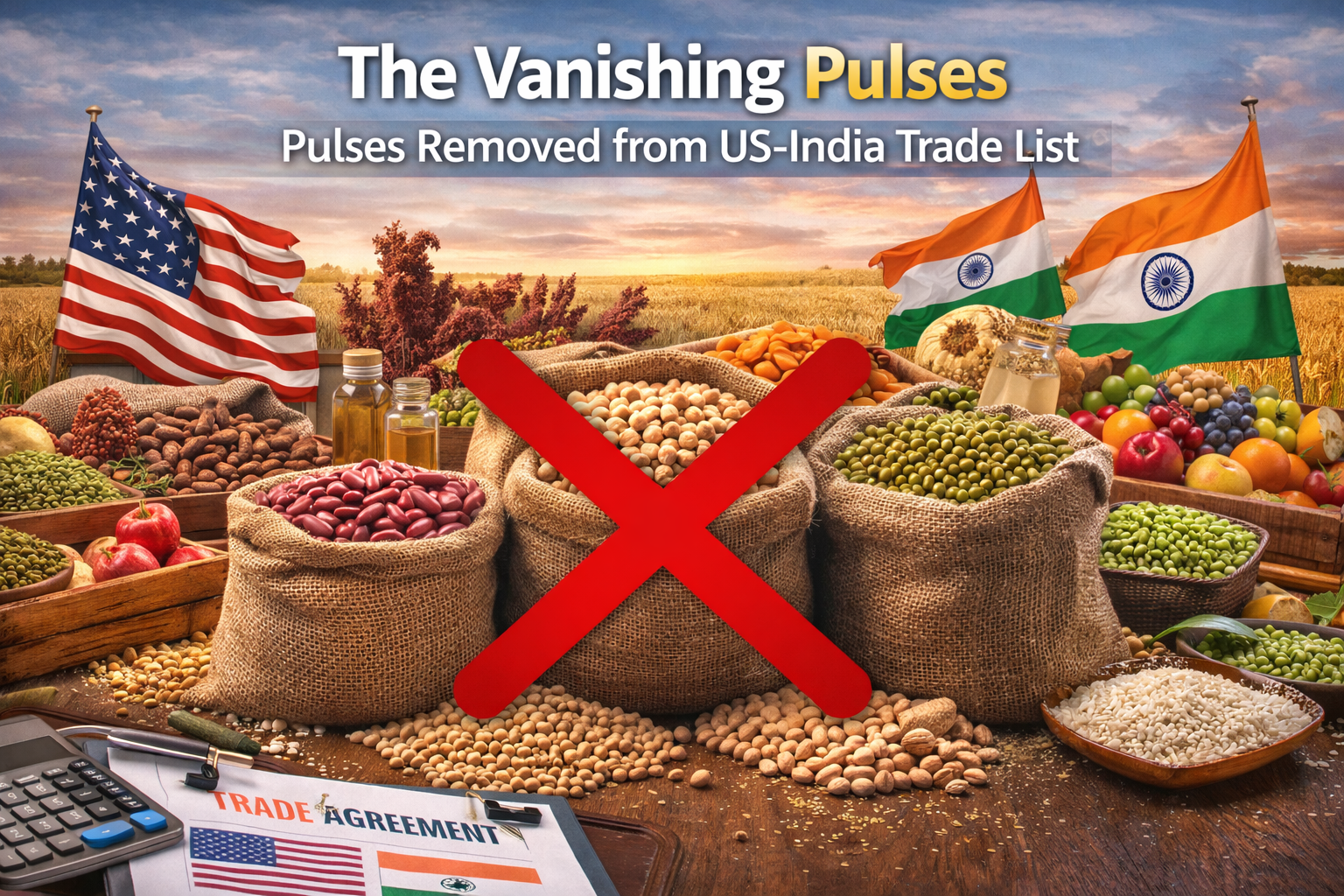
The Vanishing Pulses: What Was Removed from the Trade List
Let’s start with the agricultural section—specifically pulses.
In the earlier version of the factsheet, Washington stated that India would eliminate or reduce tariffs on US industrial goods and a broad set of agricultural products. The list included:
-
Dried distillers’ grains (DDGs)
-
Red sorghum
-
Tree nuts
-
Fresh and processed fruit
-
Certain pulses
-
Soybean oil
-
Wine and spirits
But in the updated version, pulses disappeared.
No explanation. No footnote. Just gone.
Why does that matter?
Because pulses are politically sensitive in India. They’re tied to food security, farmer incomes, and domestic agricultural stability. Any suggestion that India would open its pulse market widely to US imports could trigger domestic pushback.
Removing that reference could mean one of three things:
-
Negotiations are still ongoing.
-
India resisted that inclusion.
-
The earlier language moved faster than the agreement itself.
Trade negotiations are like chess. Sometimes a piece is moved publicly before both sides are ready to defend it.
From “Committed” to “Intends”: A Subtle but Powerful Shift
Now let’s talk about the $500 billion line.
Originally, the factsheet said:
India committed to buy more American products and purchase over $500 billion of US energy, information and communication technology, agricultural, coal, and other products.
That’s bold. “Committed” signals obligation.
But in the revised version, the language changed to:
India intends to buy more American products and purchase over $500 billion of US energy, information and communication technology, coal, and other products.
Two important changes happened here.
First, “committed” became “intends.”
Second, agricultural goods were removed from the $500 billion purchase description.
That’s not just semantics.
“Committed” suggests binding political resolve. “Intends” signals aspiration. It gives room for adjustment if economic conditions shift.
In global trade diplomacy, that one word swap is like shifting from ink to pencil.
Agricultural Goods Quietly Drop from the $500 Billion Basket
There’s another layer here.
In the original draft, agricultural products were explicitly included in India’s proposed large-scale purchases. In the updated version, that reference was removed.
So now the purchase basket includes:
-
Energy
-
Information and communication technology
-
Coal
-
Other unspecified products
But not agricultural goods.
Why might this be significant?
Agriculture in India is not just an economic sector—it’s politically explosive. Rural voters matter. Farmer unions are powerful. And any perception that India is opening its agricultural market too aggressively could create domestic resistance.
By removing agriculture from the $500 billion framing, negotiators may be narrowing the focus to sectors where alignment is easier.
Energy? Strategic.
Technology? Strategic.
Coal? Industrial.
Agriculture? Politically complex.
See the pattern?
Digital Services Tax: Another Clause Softened
The original factsheet included strong language about India removing its digital services taxes (DST). It also stated that India committed to negotiating bilateral digital trade rules prohibiting customs duties on electronic transmissions.
That line is gone.
The revised version now states only that:
India committed to negotiate a robust set of bilateral digital trade rules that address discriminatory or burdensome practices and other barriers to digital trade.
Notice what disappeared?
-
The explicit removal of digital services taxes.
-
The prohibition on customs duties on electronic transmissions.
Digital trade is one of the most sensitive issues between the US and India. Washington has long criticized India’s digital services taxes as discriminatory toward American tech giants.
By removing the language about eliminating those taxes, the revised document signals that this issue is not yet settled.
Negotiations continue.
What India Gains: Tariff Reductions from 50% to 18%
Now let’s shift perspective. What does India get from this interim trade agreement?
Quite a bit.
Under the framework, duties on a wide range of Indian exports to the United States are set to drop from 50% to 18%.
That’s not small change.
The reduced tariffs apply to sectors including:
-
Textiles and garments
-
Leather and footwear
-
Plastic and rubber goods
-
Organic chemicals
-
Home decor products
-
Artisanal items
-
Select machinery categories
For Indian exporters, this is a major opening. US India Trade Deal
Think about it. A tariff drop from 50% to 18% dramatically changes price competitiveness in the US market. It makes Indian goods more attractive relative to competitors.
In industries like textiles and footwear, margins are tight. A tariff shift like this can reshape supply chains.
The Backstory: Why Talks Stalled in the First Place
This agreement didn’t emerge in calm waters.
Trade talks between India and the US had faltered after Washington imposed 50% tariffs on imports from New Delhi.
Of that total:
-
A 25% duty was introduced in August.
-
Washington accused India of indirectly fueling Russia’s “war machine” in Ukraine through energy purchases.
That accusation complicated negotiations. It injected geopolitics into trade.
So this interim agreement isn’t just about tariffs. It’s about recalibration.
It signals that both sides prefer economic engagement over escalation.
A Year of Negotiations: Why It Took So Long
Negotiations began in February 2025. Nearly a year of discussions followed.
Multiple rounds. Technical teams. Political signaling.
Trade deals between two major economies don’t move quickly. They’re layered with:
-
Domestic politics
-
Strategic calculations
-
Industry lobbying
-
Geopolitical alignments
The fact that this is labeled an “interim agreement” tells you something important.
This isn’t the final chapter.
It’s a bridge.
Language in Trade Diplomacy: Why Words Matter More Than You Think
Let’s pause for a second.
Why are analysts obsessing over a few missing words?
Because trade diplomacy runs on language.
“Will” versus “may.”
“Commit” versus “intend.”
“Including” versus silence.
These shifts affect investor expectations. They affect domestic political messaging. They affect how binding the agreement feels.
Think of it like a contract. If a clause disappears, lawyers ask why.
In this case, the revisions suggest that some areas—particularly agriculture and digital taxes—remain under negotiation.
Strategic Signals: What Washington and New Delhi Are Telling Each Other
The revisions could serve multiple strategic purposes:
-
Avoiding domestic backlash in India over agricultural liberalization.
-
Giving flexibility on digital services taxes.
-
Reducing political liability tied to the $500 billion purchase target.
-
Signaling that details remain fluid.
Both governments need to sell this deal domestically.
In the US, the administration wants to show strong economic diplomacy.
In India, leaders must balance global alignment with domestic sensitivities.
It’s a delicate dance.
Energy and Technology: The Core of the Partnership
One area that remains firmly emphasized is energy and information technology.
India’s growing energy demand makes the US an attractive supplier. American LNG and coal exports could expand significantly.
Meanwhile, technology cooperation strengthens strategic ties in a rapidly digitizing global economy.
These sectors are less politically volatile than agriculture and offer clearer mutual benefit.
If this agreement has a stable core, it’s here.
What Happens Next? Interim Means Ongoing
An interim agreement is, by definition, incomplete.
The revised factsheet suggests that:
-
Agricultural negotiations remain unsettled.
-
Digital tax discussions continue.
-
Purchase targets are aspirational rather than binding.
Expect more rounds of technical discussions.
Expect more wording adjustments.
And expect both governments to frame progress carefully.
Trade agreements are rarely static documents. They evolve.
Conclusion
US India Trade Deal, So what do we really have here?
We have an interim US India Trade Deal agreement that reduces tariffs and strengthens cooperation in energy and technology. That’s real progress.
But we also have a revised factsheet that removes references to pulses, softens purchase commitments from “committed” to “intends,” and eliminates explicit language about digital services taxes.
In other words, we have a deal that’s still breathing.
Not collapsing. Not exploding. Just evolving.
And sometimes, evolution is exactly how durable agreements are built.
US India Trade Deal diplomacy isn’t a straight line. It’s more like a river—curving, adjusting, responding to terrain.
The revisions to the US factsheet don’t necessarily signal retreat. They signal negotiation in motion.
And in a world where geopolitics and economics are deeply intertwined, flexibility may be the most valuable clause of all.
Stay tuned. This story isn’t over.